Path Sum III OR Number of paths with target sum
Given the
root of a binary tree and an integer targetSum, return the number of paths where the sum of the values along the path equals targetSum.The path does not need to start or end at the root or a leaf, but it must go downwards (i.e., traveling only from parent nodes to child nodes).
Example 1:
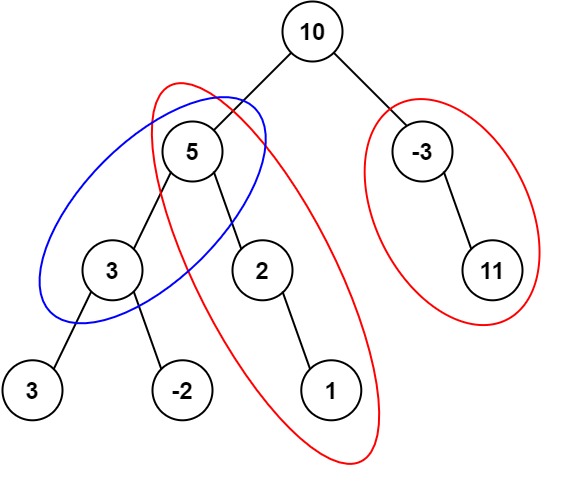
Input: root = [10,5,-3,3,2,null,11,3,-2,null,1], targetSum = 8
Output: 3
Explanation: The paths that sum to 8 are shown.
class Solution
{
public:
void helper(TreeNode *root, int &ans,
map<long long int, long long int> &mp,
long long int sum, int &target)
{
if (root == NULL)
return;
sum += root->val;
if (mp.find(sum - target) != mp.end())
ans += mp[sum - target];
mp[sum]++;
helper(root->left, ans, mp, sum, target);
helper(root->right, ans, mp, sum, target);
mp[sum]--;
}
int pathSum(TreeNode *root, int targetSum)
{
map<long long int, long long int> mp;
mp[0]++;
int ans = 0;
helper(root, ans, mp, (long long int)0, targetSum);
return ans;
}
};

Comments
Post a Comment